News Story
The Green Table is a powerful one-act ballet choreographed by Kurt Jooss in 1932. Here we take a look at the history and context of this timeless work.
Jooss was one of the most significant European choreographers of the 20th-century and a pioneer of Tanztheater (dance theatre), a form that fused classical ballet technique with expressionist drama. Deeply committed to creating socially conscious art, Jooss believed dance should engage with the political realities of its time rather than exist purely as entertainment. His work combined rigorous structure with emotional intensity – a balance that is strikingly evident in The Green Table.
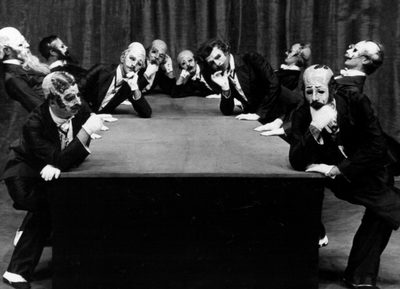
Premiered amidst brewing global conflict in the early 1930s, the ballet was created at a time of deep instability in Germany. The country was grappling with the aftermath of World War I, economic depression, and the rapid rise of extremist politics. In 1933, Adolf Hitler and the Nazi Party would come to power, altering Germany’s political and cultural landscape. Tensions across Europe were escalating, and the threat of another catastrophic war loomed. It was within this climate of anxiety, nationalism and political manoeuvring that Jooss conceived The Green Table.
The ballet was originally created for an international choreography competition in Paris, organised by the Archives internationales de la danse. Rather than presenting a decorative or abstract work, Jooss chose to confront the politics of his day directly. His decision was bold: The Green Table opens and closes with a group of diplomats negotiating around a green-covered table, posturing and debating while Death lurks nearby. Between these framing scenes, we witness the human cost of their decisions – soldiers, mothers, refugees and civilians caught in the machinery of war.
Nearly a century later, its message remains resonant.
The ballet’s plot focuses on the futility of war, highlighting the ignorance and self-interest of political leaders and the devastating impact of their choices on ordinary lives. These themes are communicated through dramatic and symbolic movement, expressionist gesture and the haunting recurring figure of Death. Nearly a century later, its message remains resonant.
The ballet was first performed in Paris at the Théâtre des Champs-Élysées, where it received an overwhelmingly positive response and won first prize in the competition. It was performed by Ballet Jooss – the company founded and directed by Kurt Jooss – which he had established in 1928 after leaving the Folkwang School in Essen, Germany. Ballet Jooss was created as a vehicle for his vision of dance theatre: a company of highly trained dancer-actors capable of delivering both technical precision and profound dramatic expression.
...a defining anti-war statement of the 20th-century.
Following the Nazis rise to power in 1933, Jooss refused to dismiss the Jewish members of his company, a stance that made his position in Germany untenable. As a result, Ballet Jooss went into exile. During the 1930s and 40s, the company was primarily based in Dartington Hall in Devon, England, becoming a vital part of Britain’s cultural life while touring extensively across Europe and the United States. This period of exile helped to spread Jooss’s choreographic influence internationally and cemented The Green Table as a defining anti-war statement of the 20th-century.
Since its premiere, The Green Table has been performed by major ballet companies worldwide, notably by Joffrey Ballet, Dutch National Ballet, and of course by BRB. We last performed the ballet in the early 1990s. Each revival reaffirms the ballet’s enduring relevance and its reminder of the consequences of political indifference and human conflict.
The Green Table will be performed as part of the Sir Peter Wright Centenary on 18 June and in our triple bill 20th-Century Masterpieces, which premieres on 19 June 2026.
The Green Table is supported by donations from Mr Stuart Sweeney and Fern & Clive Potter.