Behind the unity of Swan Lake’s corps de ballet: Répétiteur Laëtitia Lo Sardo on precision, stamina and synchronicity
News & Stories 27 Aug 2026News Story
There is something mesmerising about watching the corps de ballet in Swan Lake. More than 30 dancers appear to move as one, maintaining intricate formations with extraordinary precision. But beneath that apparent effortlessness lies meticulous rehearsal, with every movement, musical count and eyeline carefully considered.
So, how do more than 30 individual dancers become one? Here, Répétiteur Laëtitia Lo Sardo explores what it takes to perform in the corps de ballet of Swan Lake.

Classical technique comes first
With Swan Lake, the starting point is classical ballet technique. For the corps de ballet to appear as one, everybody needs to approach the fundamental positions in exactly the same way. Everyone comes from different ballet schools and training backgrounds around the world, so there are inevitably differences in the way they have learnt to dance. A major part of the rehearsal process is refining those nuances so that, when on stage together, those individual differences disappear. Everything from the turned-out supporting leg1 and the placement of the lifted leg in an arabesque2 to the positioning of the arms and torso has to be precise. When it’s a classical ballet, classical technique comes first. But Swan Lake brings an additional layer of complexity. Once the classical foundations are established, you have to incorporate the distinctive qualities of the Swan into those positions.
Finding the swan
The Swan quality is not simply about moving the arms in a particular way. It's about the journey between positions – the exact physical pathway that takes you from one movement to the next. That is where even the smallest differences become apparent. Two dancers might arrive in exactly the same position, but if one dancer’s arm has travelled there by a different pathway, the movement will not look unified. There is also a danger of making the movement look too literal. It is very easy for Swan arms to become flappy. Instead, there needs to be a sense of resistance through the air, leading through the elbow – but not dropping it3 – as the arms travel.
The positions in Swan Lake are generally more open, creating a sense of flight, and the arms are held slightly further behind the body. That requires strength and control: you have to keep the shoulders open without flaring the ribs, maintaining the openness of the chest while still supporting the arms. Even a seemingly simple position such as having the arms crossed requires constant muscular engagement. The shoulders must remain open and the arms must maintain their height rather than becoming passive. Making sure everyone is approaching the choreography in exactly the same way can take a surprising amount of rehearsal time. It can mean spending several minutes with one dancer refining a particular detail, but that attention is what allows the whole group to eventually look identical.
Knowing why you are moving
Technical precision alone is not enough. To make the movement look unified, you also need to understand its intention. At the very beginning of Swan Lake, for example, the Swans are introduced as though they are gliding across the surface of the lake. That image immediately tells us something about how the movement should feel. The tendency can be for the upper arm to become too high as we travel across the stage, but if they imagine themselves lying on top of the water, the arms should remain level, reflecting the surface of the lake. At the same time, the feet need to be sharp, suggesting the paddling movement beneath the water.
The same principle applies when the Swans are frightened by Rothbart, Siegfried and his friends. Understanding the situation informs the quality of the movement: the fear needs to be visible in the way they hold ourselves and respond. In another formation, they imagine themselves flying before landing. The head, eyes, arms and energy of the movement all have to communicate that image. These contextual details are incredibly useful because they give everyone the same idea. When you understand not just what you are doing but why, you naturally begin to move with the same intention.
1 Turned-out supporting leg – the leg that supports the dancer's weight, with the hip, knee and foot rotated outwards.
2 Arabesque – a position where the dancer stands on one leg and lifts the other leg behind them.
3 Not drooping the elbows – keeping the elbows controlled and supported as the arms move down, rather than allowing them to collapse, or break at a large angle.

Precision in every detail
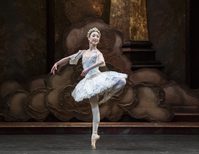
When more than 18 dancers are on stage together, the smallest differences can become surprisingly visible. All their eyelines have to match. Their fingers have to be placed consistently. The angle of the torso, the height of an arm or the level of a lifted leg can all affect the appearance of an entire formation. Sometimes we strip the choreography back completely and simply get the dancers to stand in formation. I might ask them to stand in tendu4 and give very specific visual references, such as telling one dancer that her front arm should sit behind the ear of the dancer in front of her. We can spend time with them standing in one long line simply making sure that everyone is positioned in exactly the same way. It may seem excessive to focus on such tiny details, but this is what creates the illusion of one unified body when we eventually return to the choreography.
Hearing every count
Musicality is equally important. Every movement has a precise relationship with the music. A port de bras5 might take two, four or eight counts, and you need to know exactly where each part of the movement should fall. An arm could arrive in first position6 on one count, pass through second position7 on two and reach fifth position8 on four. Even the smallest movement has a musical place. This becomes particularly important in performance, because we will work with different conductors throughout the run. You have to be able to listen and adapt while still maintaining the precision that has been rehearsed. The music is not simply something we dance to; it is what keeps the entire corps moving together.
Seeing without looking
One of the most important skills for a corps de ballet dancer is something the audience may never notice: peripheral vision. You might be looking directly ahead, but in the corner of your eye you're are constantly checking the dancers around you. You need to know where the person beside you is, where the dancer in front is and how the formation is developing around you. During rehearsals, we spend a lot of time establishing exactly where each dancer needs to be in the space. Sometimes they need to be directly behind the dancer in front; at other times, they need to occupy the gap between two dancers.
Once the choreography is familiar, much of this happens almost instinctively. But you are constantly making tiny adjustments without visibly looking at one another. And sometimes, you have to respond to something unexpected, like a change in tempo. You have to commit to the movement and adapt instantly while staying in line and in-sync with the dancers around you. It requires incredibly sharp reflexes and a lot of trust in one another.
4 Tendu – a position where one leg is extended along the floor with the foot fully pointed (can be to the front, side or back), while the other leg remains straight and support's the dancer's weight.
5 Port de bras – the term used to refer to the general movement and positioning of the arms in ballet. Literally translates from French to 'carriage of the arms'.
6 First position of the arms – both arms are held in front of the body in a rounded shape, as though gently embracing a large ball.
7 Second position of the arms – both arms are extended out to the sides at approximately shoulder height, with a gentle curve through the elbows.
8 Fifth position of the arms – both arms are raised above the head in a rounded shape.
Image gallery
A gallery slider
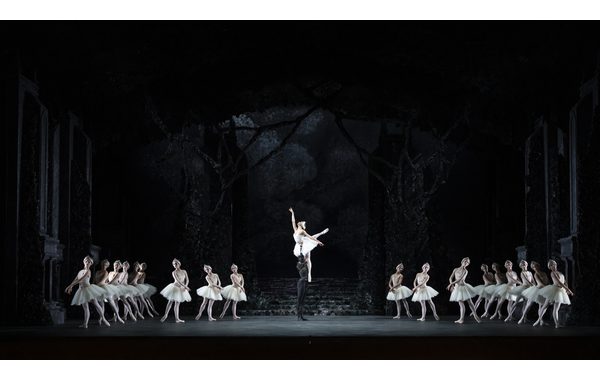
The Swan Lake corps de ballet standing in line.
© 2023 Credit : Bill Cooper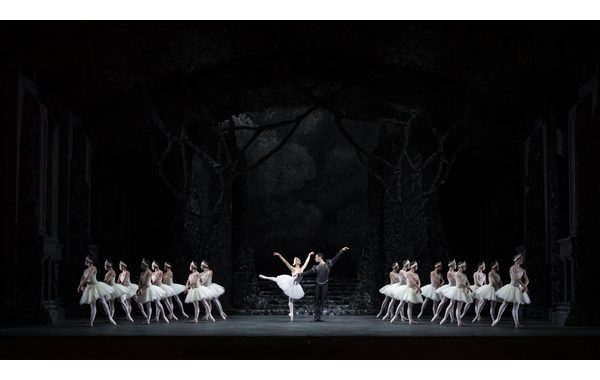
The Swan Lake corps de ballet standing in line.
© 2023 Credit : Bill CooperThe challenge of standing still
One of the most physically demanding aspects of Swan Lake is not necessarily the dancing itself. It is the moments when you have to stop. You might have been dancing continuously and be completely breathless, only to arrive in a formation where you have to stand absolutely still for an extended period of time. That stillness requires just as much control as the movement. If you are standing with one leg extended behind in tendu, there can be a temptation to shift your weight between both legs or ‘sit’ into the back leg because it provides temporary relief. Although that can feel easier in the moment, it can place additional strain on the foot and lower leg. You need to keep your weight correctly over the front leg so that the muscles designed to support the position – including the glutes and hamstrings – remain engaged.
This is particularly important in Swan Lake, which contains so much jumping and is incredibly demanding on the lower legs. After a physically intense sequence, the temptation to rest is very strong, but shifting the weight backwards can actually place more load on the calves. So you have to stay lifted and maintain the position, even when your body is desperately asking you to rest. And there is no escaping the reality of performing. You can be sweating, with sweat running down your face and neck, but if you are required to remain completely still, you simply have to stay there.
Becoming one body
While everyone is an individual dancer, as part of the corps de ballet you are one part of a much larger whole. Collectively, the dancers become one large, 18-something-body organism. That sense of togetherness develops over time. The more you rehearse together, the more sensitive you become to the dancers around you. You begin to develop almost a sixth sense – an awareness of what is happening around you without consciously having to think about it. Sometimes even breathing together helps create that feeling of unity.
But there is no shortcut. It takes a huge amount of repetition. We rehearse the Swans every day, more or less, and Swan Lake contains four acts of these demanding numbers. Most of the dancers are already accustomed to working together in other ballets, but new dancers joining the group have to naturally adjust. And because Swan Lake is so technically and physically demanding, there is even more to perfect. It is also not purely classical in its movement language. The lower half of the body remains rooted in classical technique, with the legs needing to be sharp, precise and quick, while the upper body has to incorporate the distinctive Swan qualities. The result is a very particular combination: classical precision below, stylistic interpretation above. Both have to be exact, which is harder to achieve with a larger group.
Building the stamina
Finally, there is the physical stamina required to sustain all of this. The corps de ballet needs to rehearse every day. At the beginning of the process, when the focus is on learning the choreography, we do not necessarily make the dancers rehearse everything full-out. Gradually, though, we have to build towards performance intensity. By the time we perform Swan Lake, the dancers will be at their fittest. Over the weeks of rehearsal, we progressively build their strength and stamina, with The Jerwood Centre supporting us through conditioning programmes designed to help prepare the body for the demands of the ballet. [Discover more about how BRB’s dancers are preparing for Swan Lake in our guide to the conditioning exercises taught by Rehabilitation and Conditioning Lead Esther Collacott, here.] That physical preparation also goes hand in hand with good technique. Working correctly helps you to perform the demands of the ballet safely and reduces the risk of injury.
Ultimately, what you see on stage as one seamless movement is the result of hundreds of individual decisions and countless hours of rehearsal. Every arm has been considered. Every eyeline has been checked. Every musical count has been rehearsed. Every dancer knows where she needs to be, and, just as importantly, where everyone around her needs to be. It is that extraordinary combination of individual precision and collective awareness that allows more than 30 dancers to become one.
Find out more about Swan Lake

WATCH: the making of the Cygnets in Swan Lake

WATCH: inside Céline Gittens’ pointe shoe preparations for Swan Lake

WATCH: Amelia Thompson performs one of the Act I Courtesan solos from Swan Lake

Swan Lake: the story behind Tchaikovsky's 'undanceable' score

WATCH: Swan Lake from above

223 Pointes: the pointe shoe swan sculpture inspired by BRB's Swan Lake
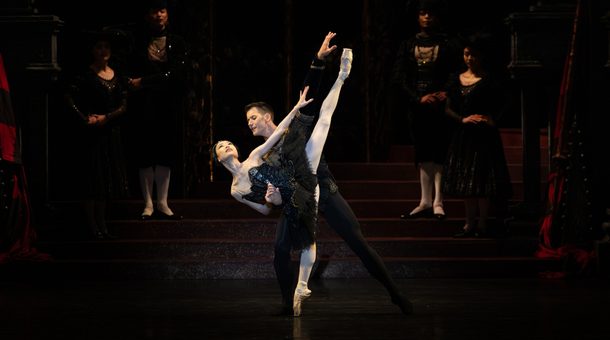
WATCH: Black Swan pas de deux from Swan Lake (Act III)

WATCH: Carlos Acosta on why pointe shoes matter

WATCH: dancer Yasemin Kayabay prepares her pointe shoes (ASMR)

WATCH: audiences react to Swan Lake

WATCH: Swan Lake Performance Trailer

Swan Lake: first look