News Story
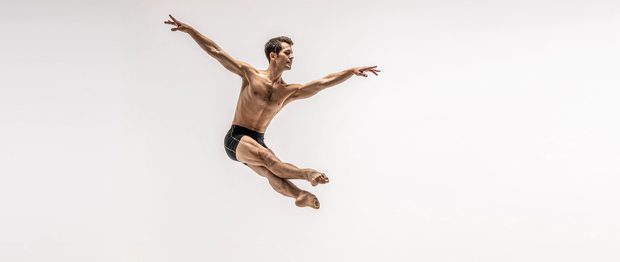
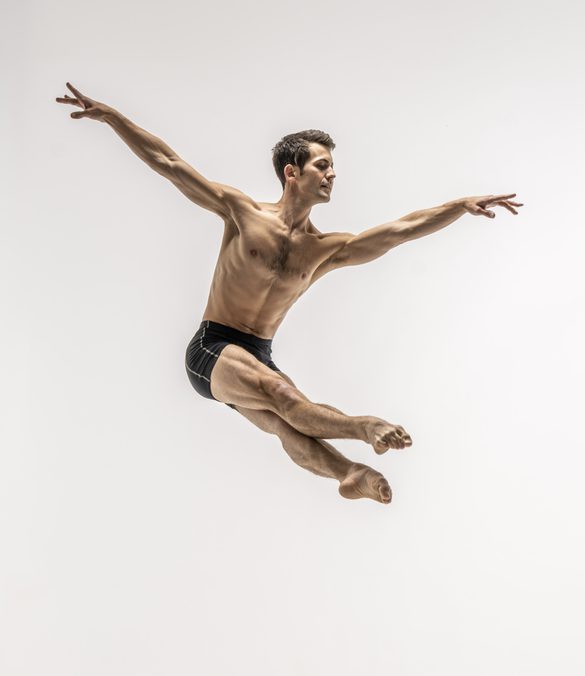
In this series, we're exploring some of ballet's most demanding steps. Here, BRB Principal Dancer Mathias Dingman and Clinical Director Dr Nick Allen break down barrel turns – a virtuosic movement traditionally performed by male dancers. Rarely seen across the classical repertoire, barrel turns famously feature in Don Quixote.
Principal Dancer Mathias Dingman on mastering barrel turns
Barrel turns are a step you rarely see in ballet. They appear in Don Quixote, sometimes in La Bayadère, but beyond that they’re uncommon. Because of this, the dancers who really know how to do them have usually come through Russian or Vaganova-based training, where the step has been valued for generations – from Vasiliev and Grigorovich to Vladimirov and Baryshnikov, who truly took it to another level.
I was fortunate growing up. One of my closest friends was Brooklyn Mack, who I believe has some of the best barrel turns in the world. We trained together from a young age at the Washington Ballet School, so I was constantly inspired by watching him. My own teacher, a Ukrainian specialist in barrel turns and 540s1, helped us build the technique step by step.
We would begin simply – repeating jeté2 into attitude3, almost like a manège4 – and then gradually introduce the backward tilt that defines the movement. That tilt is why many dancers fear barrel turns. You feel completely off balance and must trust the jump to carry you. In a way, you’re so off balance that you become balanced.
1 540 – a high, turning jump in which the dancer rotates one and a half turns in the air before landing. A traditionally male, virtuosic step.
2 (Grand) Jeté – a large, travelling leap in which the dancer splits the legs in the air. It is one of the most recognisable jumps in classical ballet.
3 Attitude – a position where one leg is lifted and bent at the knee, either in front or behind the body, while the supporting leg remains straight. It is commonly used in jumps, turns and balances.
4 Manège – a sequence of steps performed in a circular pathway around the stage or studio, usually featuring repeated jumps or turns that travel continuously in one direction.
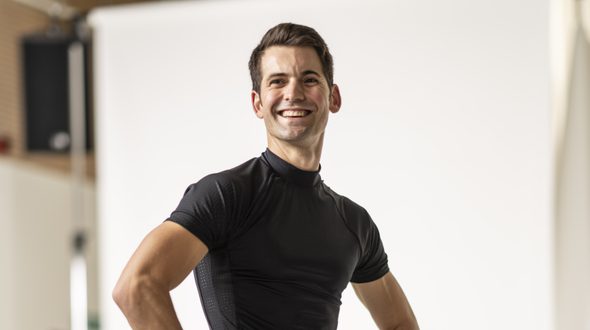
Mathias demonstrating barrel turns at the end of ballet class.
that tilt is why many dancers fear barrel turns. You feel completely off balance and must trust the jump to carry you
Landing is equally unusual. You arrive in a parallel second position5, which feels alien in classical ballet, and must immediately take off again to continue the circle. My teacher described the mechanics as two grands battements6 up and two down: a four-part rhythm of up, up, down, down. Finding that rhythm is the hardest part.
There are many ways to approach the step. Carlos Acosta, for example, would build it differently, starting with bent knees and developing the lean gradually. Barrel turns are what I’d call a ballet 'trick': every dancer executes them in a personal way, shaped by their body, coordination, and jump.
Physically, they’re among the most demanding steps we do. No part of the body ever rests. In the Don Quixote coda7, everything I perform is off my left leg – including consecutive barrel turns – followed almost immediately by grand pirouettes on the same leg. By the end, that leg is completely spent.
5 Second position – one of the five basic ballet foot positions, where the feet are placed a hip's width apart and turned outward from the hips. Parallel second (mentioned here) means the feet are apart without turnout, facing forwards instead.
6 Grands battements – a dynamic movement in which the dancer throws a straight leg high into the air and lowers it again with control.
7 Coda – the final, fast-paced section of a classical pas de deux (dance for two). The coda showcases virtuosic steps, jumps, and turns from both dancers and brings the duet to an exciting conclusion.
every dancer executes them in a personal way, shaped by their body, coordination, and jump
My preparation has changed over time. Ten years ago, it was simply practice, practice, practice. Now it’s much more about visualisation, combined with gym training and cycling to protect my joints and maintain strength. Experience teaches you how to work smarter, not just harder.
Barrel turns didn’t come naturally to me. As a teenager, I spent hours after classes ended, staying in the studio late into the evening to practise them, even when my foot was bruised. It took years to master the coordination, the rhythm, and even the musical timing. In Russia, the legs split on the upbeat, whereas in the UK, they land on the count. Adjusting to that alone took a long time.
For me, the execution of barrel turns is shaped by where you trained and who inspired you. I grew up watching Baryshnikov’s performances in Le Corsaire and La Bayadère, and I still return to them now. That inspiration, combined with years of persistence, is what made the step feel possible.
I spent hours after classes ended, staying in the studio late into the evening to practise them, even when my foot was bruised
Jerwood Feature: Clinical Director Dr Nick Allen on the physiology behind barrel turns
When we look at barrel turns from a clinical and performance perspective, they represent something we see across ballet: the balance between extraordinary skill and physical conditioning.
Historically, dancers relied heavily on skill alone. Compared with athletes, dancers often showed similar strength or aerobic capacity, but vastly superior coordination and efficiency of movement. Today, we understand that optimal performance and injury prevention sit somewhere between those two extremes.
A movement like a barrel turn is highly skilled, but it also needs what I think of as a back-up generator: the strength and conditioning that supports the technique, especially when fatigue sets in at the end of a performance.

a barrel turn is highly skilled, but it also needs what I think of as a back-up generator: the strength and conditioning that supports the technique
Biomechanically, the step is complex. The dancer works in trunk flexion with rotation through the thoracic spine, so strong trunk and lumbopelvic control are essential. Without that stability, rotational forces travel to the wrong places and increase injury risk.
At the same time, the foot and ankle must absorb and re-generate significant force on landing and take-off, transferring load through the ankle, knee, hip, and back into the next jump. Every link in that kinetic chain matters.
Because each dancer combines skill and conditioning differently, defining a single 'norm' isn’t particularly useful. Instead, we look first for symmetry and how the body responds to load, measuring peak force, rate of force development, and muscular strength across both sides. If something falls outside an expected range, we can target specific areas such as hip strength or external rotator control to reduce risk and improve execution.
we can target specific areas such as hip strength or external rotator control to reduce risk and improve execution
In practice, development is collaborative. Artistic staff guide the technical progression in the studio, while we support the physical conditioning in the gym. Sometimes a challenge that appears technical is actually about strength; other times it’s purely coordination.
That journey – from conditioning, to studio acquisition, to stage performance – is entirely normal in ballet, whether we’re working towards barrel turns or rehabilitating an injury. The goal is always the same: enabling dancers to perform at the highest level, as safely and sustainably as possible.
the goal is always the same: enabling dancers to perform at the highest level, as safely and sustainably as possible
BRB houses the Jerwood Centre for the Prevention and Treatment of Dance Injuries – a specialised facility for the Company providing world-class medical, rehabilitation, research and educational support to keep our dancers healthy, help them recover from injuries and reach peak performance.
The Jerwood Centre for the Prevention & Treatment of Dance Injuries is generously supported by the Royal Opera House Benevolent Fund.
Find out more about The Jerwood Centre

The Jerwood Centre: the strength behind every step in Swan Lake

Inside BRB’s AI Nutrition Project with Clinical Director Dr Nick Allen

Dr Nick Allen on rest, recovery and preparing for a new season
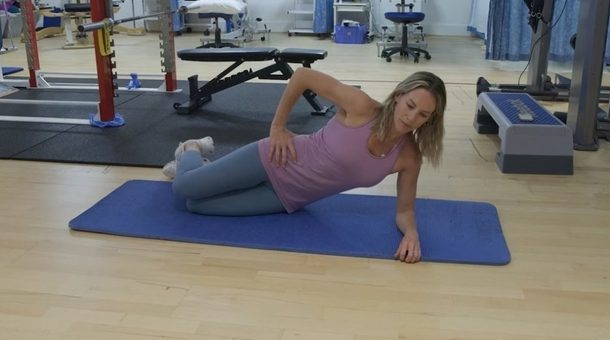
How do dancers train for Swan Lake? Rehabilitation and Conditioning Lead Esther Collacott on her go-to conditioning exercises
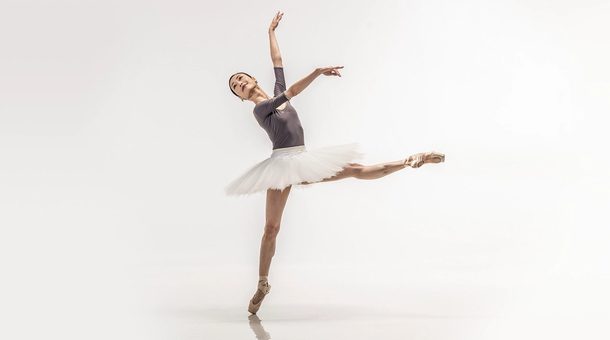
Exploring ballet's hardest moves: the 32 fouettés from Swan Lake

Dealing with injury as a ballet dancer: insights from Hannah Martin and Nick Allen
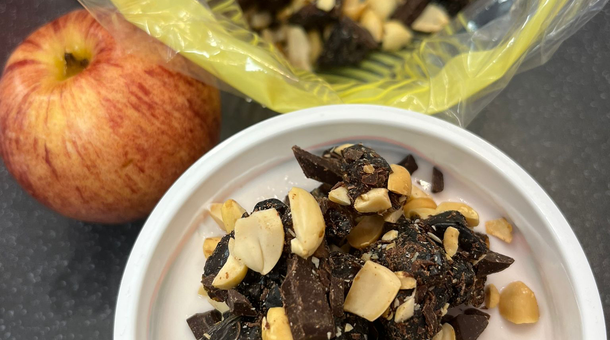
Fuel for performance: inside dancer nutrition at Birmingham Royal Ballet
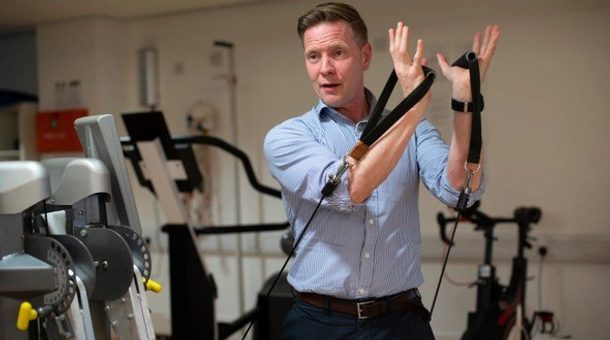
The Jerwood Centre: supporting dancers on tour
Announcing a strategic partnership with University of Birmingham

Post-performance recovery, health and self-care with Matilde Rodrigues
WATCH: The Silence After Applause